

Build an exchange
This tutorial walks through the example app in
python/example: a small currency
exchange built on django-pledge. Traders hold wallets in EUR, USD and BTC. They deposit money,
trade between currencies, pay each other and withdraw. The broker earns a fee on every trade.
You don’t need to know double-entry bookkeeping. One rule is enough: money never appears or disappears, it only moves from one account to another. Every step below shows which accounts move.
The code excerpts are real but trimmed. # ... marks the cuts.
Run it #
-
Start the example. From the repository root:
docker compose --profile example up --build exampleThe start script creates a database
exchange, runs the migrations, funds the exchange with money to trade, and creates an admin user (admin/admin). -
Open http://localhost:8000. The admin is at
/admin/.
1. Set up #
The project is a normal Django project. django_pledge is one more app, next to your own:
INSTALLED_APPS = [
    # ...
    "django_pledge",
    "exchange",
]
python manage.py migrate creates the extension. If your app connects with its own database
role, give it the grants once. See Django setup for the details.
The exchange keeps its business rules in settings:
# Currency code -> decimal places of its smallest unit.
EXCHANGE_CURRENCIES = {"EUR": 2, "USD": 2, "BTC": 8}
# Only bought and sold on the exchange: no bank or card deposits and payouts.
EXCHANGE_CRYPTO = {"BTC"}
# Reference prices in EUR; a real exchange would read these from a price feed.
EXCHANGE_PRICES_EUR = {"EUR": "1", "USD": "0.92", "BTC": "58000"}
EXCHANGE_FEE_RATE = "0.0025"
# What the card provider charges the broker per card deposit.
EXCHANGE_CARD_FEE_RATE = "0.015"
All ledger work lives in one module, exchange/services.py. The views only parse forms and call it.
2. Model your data next to the ledger #
Ledger rows can’t change, so your own data goes in your own models. A Trader is a plain model
with a name. A Wallet links a trader to one ledger account per currency:
class Wallet(models.Model):
    """A trader's ledger account in one currency."""

    trader = models.ForeignKey(Trader, models.PROTECT, related_name="wallets")
    currency = models.CharField(max_length=5)
    account = models.OneToOneField(
        "pledge.Account", models.PROTECT, db_constraint=False, related_name="wallet"
    )
    # What traders see and type; the ledger's own id stays internal.
    number = models.CharField(
        max_length=10, unique=True, default=new_account_number, editable=False
    )
db_constraint=False is required: the pledge models sit on database views, and a view can’t be
the target of a foreign key. Joins and filters still work, like
Wallet.objects.filter(account__balance__gt=0).
The number is what traders see and type when they pay each other. It has ten digits, and the
last one is a Luhn check digit, so a typo is caught
before any lookup.
The broker’s own accounts #
Every transfer has two sides. When Alice deposits 100 EUR, the money has to come from an account. So the exchange keeps its own accounts, five per currency:
class HouseAccount(models.Model):
    """The exchange's own ledger accounts, one of each kind per currency."""

    class Kind(models.TextChoices):
        LIQUIDITY = "liquidity", "Liquidity (the exchange's inventory)"
        FEES = "fees", "Fee revenue"
        CARD = "card", "Card provider (not yet paid out)"
        BANK = "bank", "Our bank account"
        CARD_COSTS = "card_costs", "Card processing costs"

    kind = models.CharField(max_length=20, choices=Kind.choices)
    currency = models.CharField(max_length=5)
    account = models.OneToOneField(
        "pledge.Account", models.PROTECT, db_constraint=False, related_name="house_account"
    )
| Kind | What it is | Balance |
|---|---|---|
liquidity |
The currency the exchange holds to sell to traders | zero or more |
fees |
What the broker earned on trades | zero or more |
bank |
Money that came in from, or went out to, real bank accounts | zero or less |
card |
Card payments the card provider still holds for us | usually less than zero |
card_costs |
Fees the card provider charged the broker | zero or less |
The last three stand for money outside the ledger. When 100 EUR arrives from Alice’s bank,
bank goes to −100 and Alice’s wallet to +100. The negative balance says: 100 EUR came in from
outside. That is how every currency sums to zero.
house_account() creates each one on first use, with balance rules that match the table:
# Money outside the ledger: these balance everything inside it, so they never go above zero.
EXTERNAL_KINDS = {HouseAccount.Kind.CARD, HouseAccount.Kind.BANK, HouseAccount.Kind.CARD_COSTS}
# Money paid out to cards can exceed what the provider holds for us: then we owe the provider.
MAY_GO_POSITIVE = {HouseAccount.Kind.CARD}

def house_account(kind: str, currency: str) -> Account:
    # ...
    is_external = kind in EXTERNAL_KINDS
    account = Account.objects.create(
        name=f"house:{kind}:{currency}",
        currency=currency,
        allow_negative_balance=is_external,
        allow_positive_balance=not is_external or kind in MAY_GO_POSITIVE,
        metadata={"house": kind},
    )
    HouseAccount.objects.create(kind=kind, currency=currency, account=account)
    return account
pledge enforces these rules on every transfer. Liquidity can’t go below zero, so the exchange can never sell BTC it doesn’t have. The bank account can’t go above zero, so the exchange can never pay out more than came in.
Before anyone trades, the owner puts capital in. The start script runs
python manage.py fund_liquidity EUR 1000000 (and the same for USD and BTC):
def fund_liquidity(currency: str, amount: Decimal) -> Transfer:
    """The owner's capital arrives in our bank account and becomes the exchange's inventory."""
    amount = check_amount(currency, amount)
    bank = house_account(HouseAccount.Kind.BANK, currency)
    liquidity = house_account(HouseAccount.Kind.LIQUIDITY, currency)
    return bank.transfer(liquidity, amount, metadata={"kind": "funding"})
bank EUR → liquidity EUR 1000000.00 funding
3. Open a trader #
On Traders › New trader, type a name.
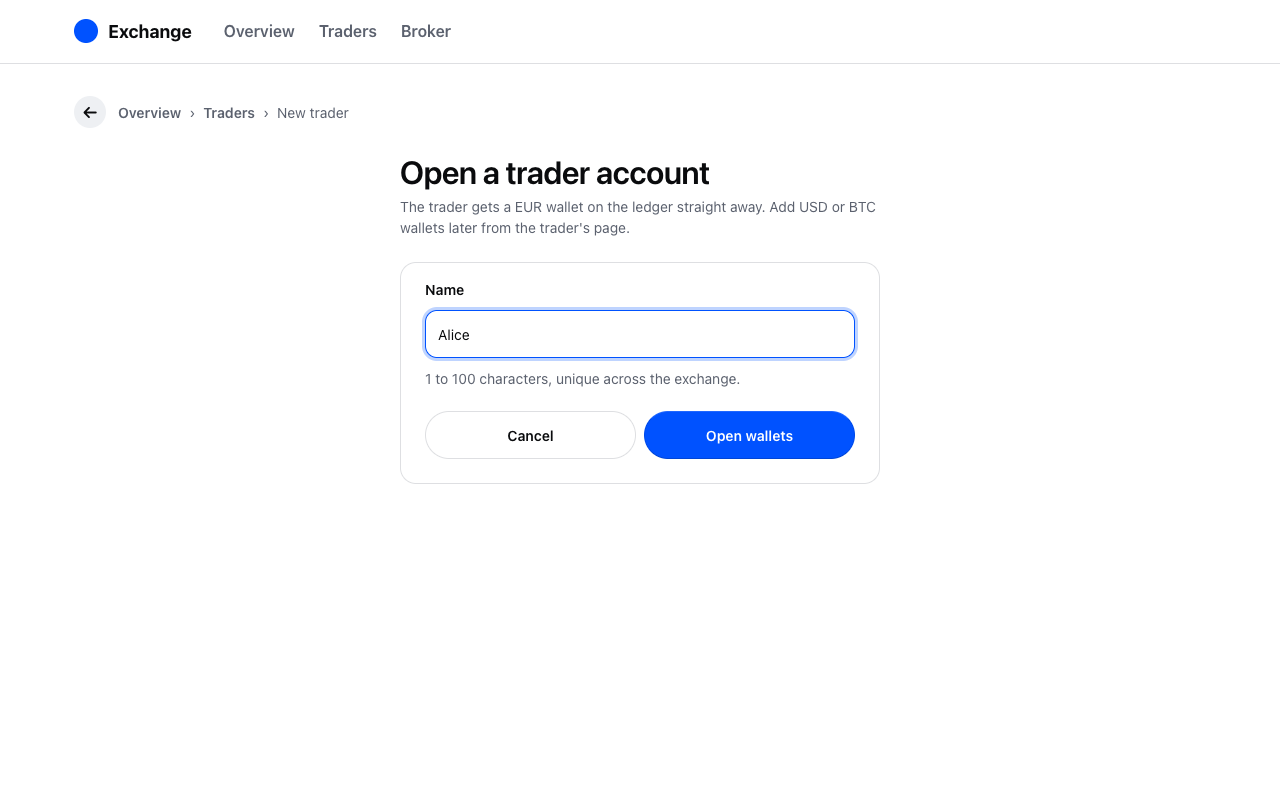
Alice gets a EUR wallet straight away, and buttons to add the other currencies. A trade needs two wallets, so the Exchange tab asks her to open another one first.
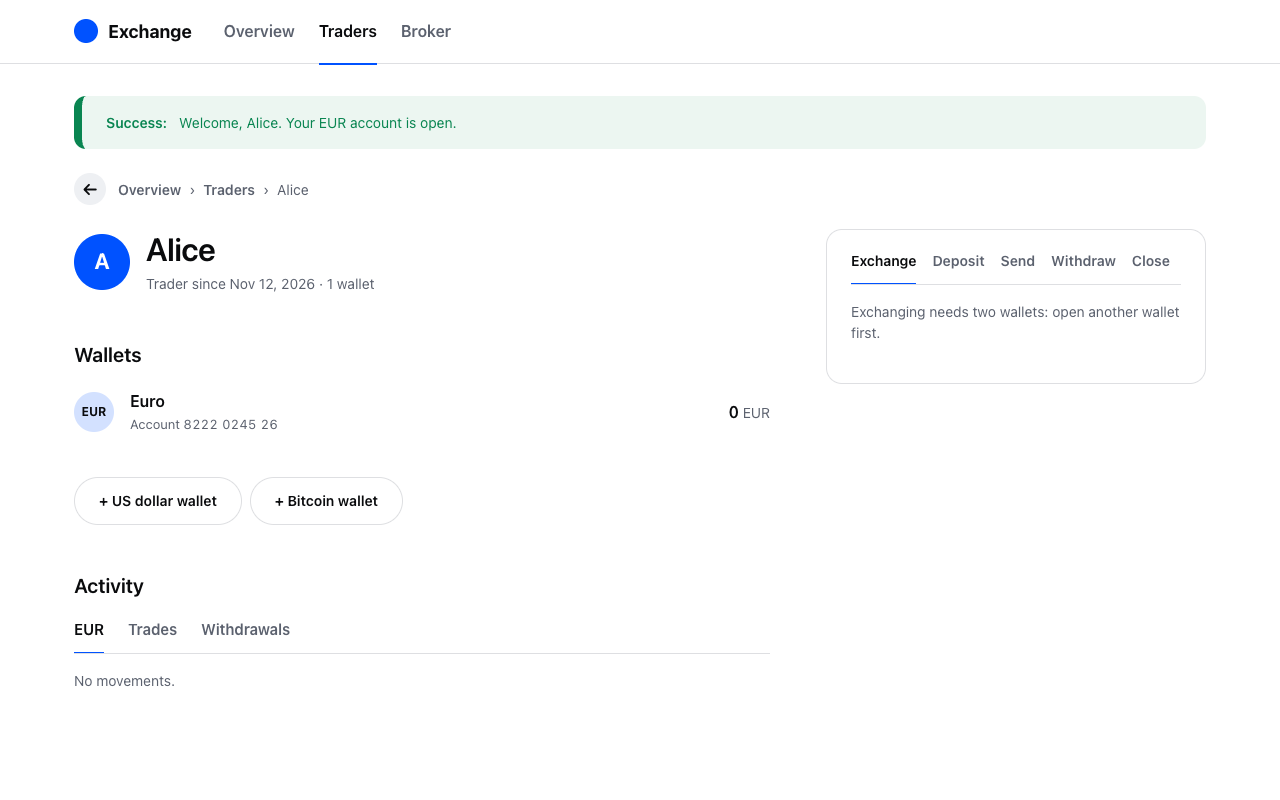
Each wallet is a new ledger account. Both rows are created in one transaction, so you never get a wallet without an account or the other way round:
def open_wallet(trader: Trader, currency: str) -> Wallet:
    """Open the trader's ledger account in one more currency."""
    # ...
    with transaction.atomic():
        account = Account.objects.create(
            name=f"trader:{trader.pk}:{currency}",
            currency=currency,
            allow_negative_balance=False,
            metadata={"trader": trader.pk},
        )
        return Wallet.objects.create(trader=trader, currency=currency, account=account)
In the ledger: one new account, balance 0. No money moves. allow_negative_balance=False
means pledge itself refuses any transfer that would overdraw the wallet, however your code calls it.
4. Deposit money #
On the Deposit tab, Alice deposits 1,000 EUR by bank transfer, then 250 EUR by card.
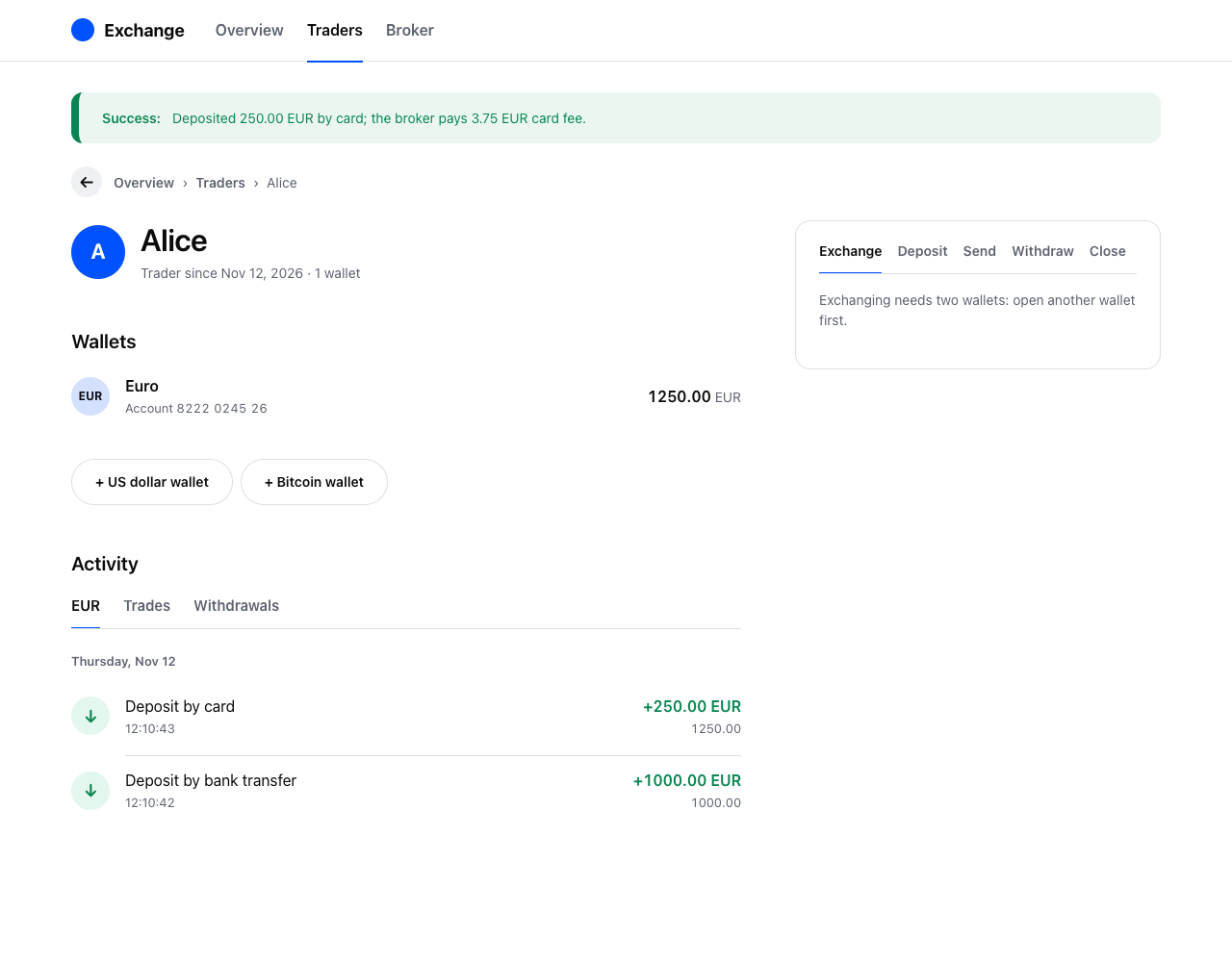
A bank deposit is one transfer. A card deposit is two: the card provider keeps 1.5%, and the
broker pays that fee, not Alice. Both legs go into one bulk_create, so they’re booked together
or not at all:
def deposit(
    trader: Trader | int,
    currency: str,
    amount: Decimal,
    method: str = "bank",
    *,
    transfer_id: TransferId | None = None,
) -> Transfer:
    # ...
    account = wallet(trader, currency).account
    metadata = {"kind": "deposit", "method": method}
    if method == "bank":
        bank = house_account(HouseAccount.Kind.BANK, currency)
        return bank.transfer(account, amount, id=transfer_id, metadata=metadata)
    transfer_id = transfer_id or TransferId.new()
    card = house_account(HouseAccount.Kind.CARD, currency)
    legs = [
        Transfer(
            id=transfer_id, from_account=card, to_account=account, amount=amount, metadata=metadata
        )
    ]
    if fee := card_fee(currency, amount):
        legs.append(
            Transfer(
                id=card_fee_id(transfer_id),
                from_account=house_account(HouseAccount.Kind.CARD_COSTS, currency),
                to_account=card,
                amount=fee,
                metadata={"kind": "card_fee"},
            )
        )
    return Transfer.objects.bulk_create(legs)[0]
In the ledger:
bank EUR        →  Alice EUR   1000.00   deposit by bank transfer
card EUR        →  Alice EUR    250.00   deposit by card
card_costs EUR  →  card EUR       3.75   card processing fee
The card provider now holds 246.25 EUR for us: 250 minus its fee. It shows as card at −246.25.
The deposit form carries a fresh transfer id in a hidden field, and the view passes it as
transfer_id. If the form is posted twice, pledge sees the same id and books it once. A real app
would use the payment provider’s id.
The fee leg needs its own id that is just as stable. card_fee_id() derives it from the deposit id
with uuid.uuid5, so a retry sends the same pair of ids.
5. Trade #
Alice adds a Bitcoin wallet and opens the Exchange tab. She sells 100 EUR for BTC and clicks Preview first.
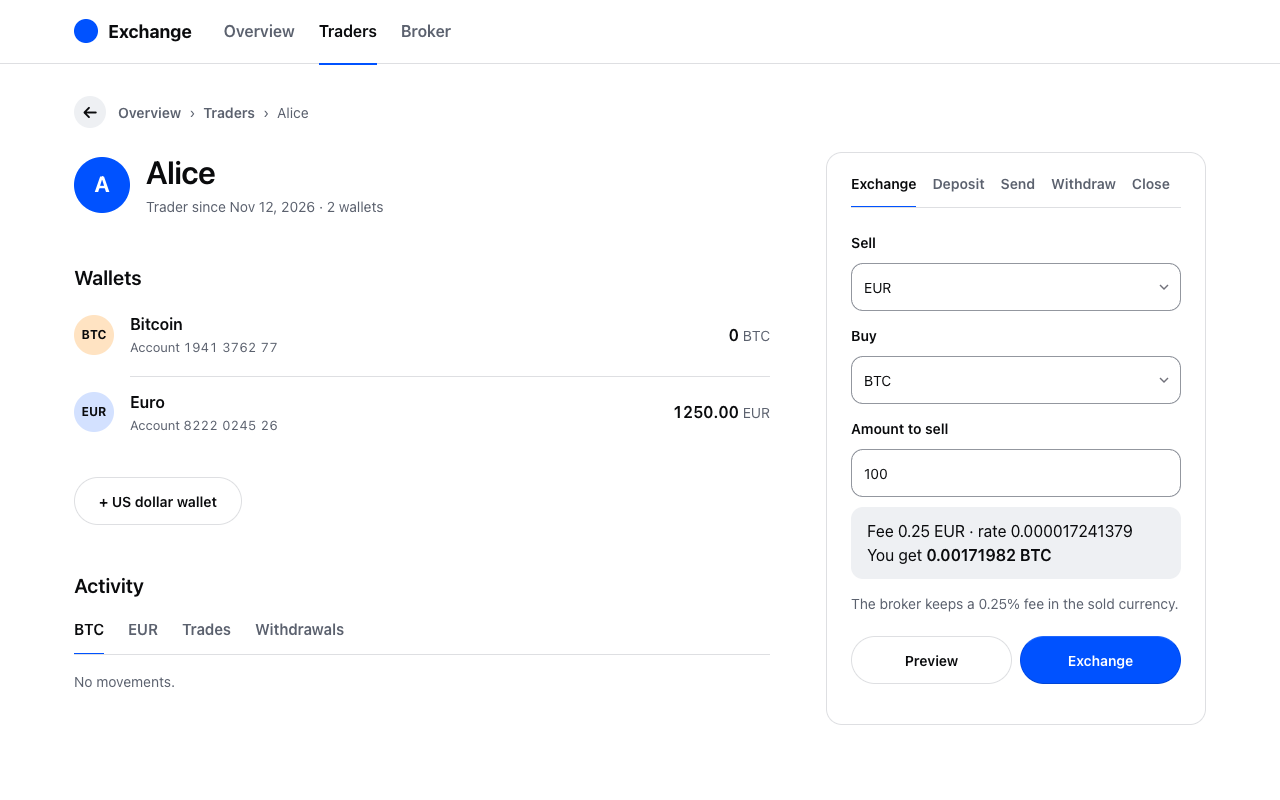
The preview is a plain GET with the inputs in the URL, like /traders/1/?sell=EUR&buy=BTC&amount=100.
It calls quote(), which books nothing:
def quote(sell_currency: str, buy_currency: str, sell_amount: Decimal) -> Quote:
    """Price a conversion: the fee is taken from the sold amount, the rest is converted.

    Both roundings favour the exchange: the fee rounds up and the bought amount rounds down.
    """
    # ...
    rate = Decimal(prices[sell_currency]) / Decimal(prices[buy_currency])
    fee_rate = Decimal(settings.EXCHANGE_FEE_RATE)
    fee = (sell_amount * fee_rate).quantize(smallest_unit(sell_currency), rounding=ROUND_UP)
    buy_amount = ((sell_amount - fee) * rate).quantize(buy_unit, rounding=ROUND_DOWN)
    # ...
She clicks Exchange.
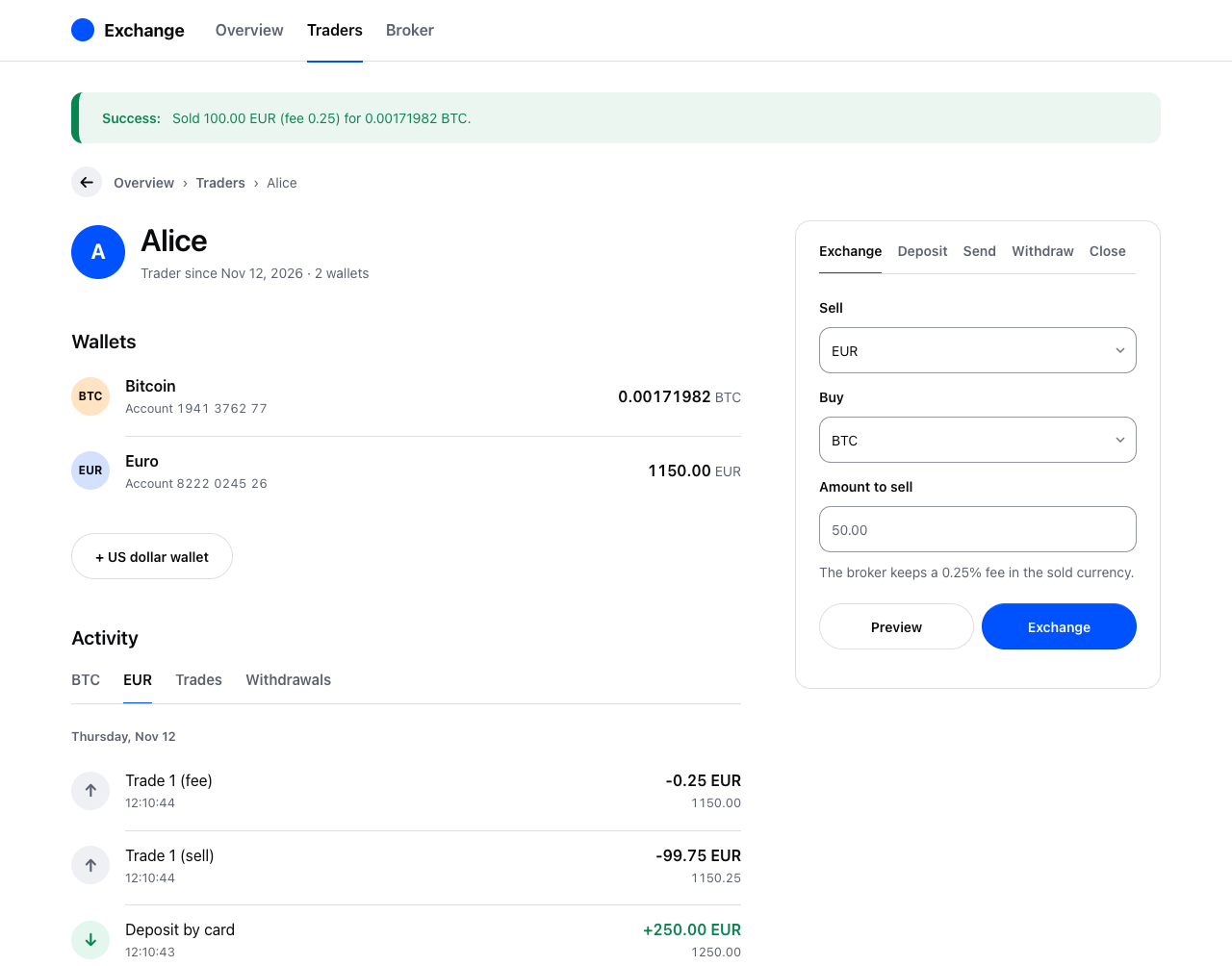
pledge never converts currencies: a transfer always stays within one currency. So a trade is three transfers, and the exchange’s liquidity accounts sit in the middle. Alice pays EUR into the exchange’s EUR inventory, and the exchange pays BTC out of its BTC inventory:
def trade_legs(trade: Trade, trader_sell: Account, trader_buy: Account) -> list[Transfer]:
    """pledge never converts, so a trade is one transfer per currency plus the fee."""
    sell, buy = trade.sell_currency, trade.buy_currency
    metadata = {"kind": "trade", "trade": trade.pk}
    return [
        Transfer(
            id=trade.sell_transfer_id,
            from_account=trader_sell,
            to_account=house_account(HouseAccount.Kind.LIQUIDITY, sell),
            amount=trade.net_amount,
            metadata={**metadata, "leg": "sell"},
        ),
        Transfer(
            id=trade.fee_transfer_id,
            from_account=trader_sell,
            to_account=house_account(HouseAccount.Kind.FEES, sell),
            amount=trade.fee,
            metadata={**metadata, "leg": "fee"},
        ),
        Transfer(
            id=trade.buy_transfer_id,
            from_account=house_account(HouseAccount.Kind.LIQUIDITY, buy),
            to_account=trader_buy,
            amount=trade.buy_amount,
            metadata={**metadata, "leg": "buy"},
        ),
    ]
In the ledger:
Alice EUR      →  liquidity EUR   99.75        sell
Alice EUR      →  fees EUR         0.25        fee
liquidity BTC  →  Alice BTC        0.00171982  buy
Each currency still sums to zero on its own. The three legs go into one bulk_create: if Alice
lacks the EUR, or the exchange lacks the BTC, nothing is booked.
Retries and failures #
A Trade row stores the quote and the three transfer ids before pledge is called:
class Trade(models.Model):
    trader = models.ForeignKey(Trader, models.PROTECT, related_name="trades")
    # Chosen by the client, so a retried request finds this trade instead of making a new one.
    request_id = models.CharField(max_length=64)
    # ...
    # Stored before pledge is called, so every retry sends the same transfer ids.
    sell_transfer_id = TransferIdField(default=TransferId.new, unique=True, editable=False)
    fee_transfer_id = TransferIdField(default=TransferId.new, unique=True, editable=False)
    buy_transfer_id = TransferIdField(default=TransferId.new, unique=True, editable=False)
place_trade() finds or creates the trade by request_id, then runs it:
def execute_trade(trade_id: int) -> tuple[Trade, list[Transfer]]:
    # ...
    with transaction.atomic():
        trade = Trade.objects.select_for_update().get(pk=trade_id)
        if trade.status != Status.FAILED:
            trader_sell = wallet(trade.trader_id, trade.sell_currency).account
            trader_buy = wallet(trade.trader_id, trade.buy_currency).account
            try:
                # Each pledge call runs in a savepoint, so a refusal leaves this transaction usable.
                transfers = Transfer.objects.bulk_create(trade_legs(trade, trader_sell, trader_buy))
            except (pledge.NegativeBalanceNotAllowed, pledge.AccountClosed) as exc:
                trade.status = Status.FAILED
                trade.failure = failure_code(exc, {trader_sell.id, trader_buy.id})
            else:
                trade.status = Status.COMPLETED
            trade.save(update_fields=["status", "failure"])
    # ...
Send the same request again and pledge receives the same three ids. It returns the transfers it
already booked and moves no money. A refused trade is saved as failed, with a reason:
insufficient_funds when Alice’s wallet is short, insufficient_liquidity when the exchange’s is.
6. Pay another trader #
Bob signs up and adds a US dollar wallet. Each wallet has its own account number, and that number is all a trader ever sees. The ledger’s own account id stays internal.
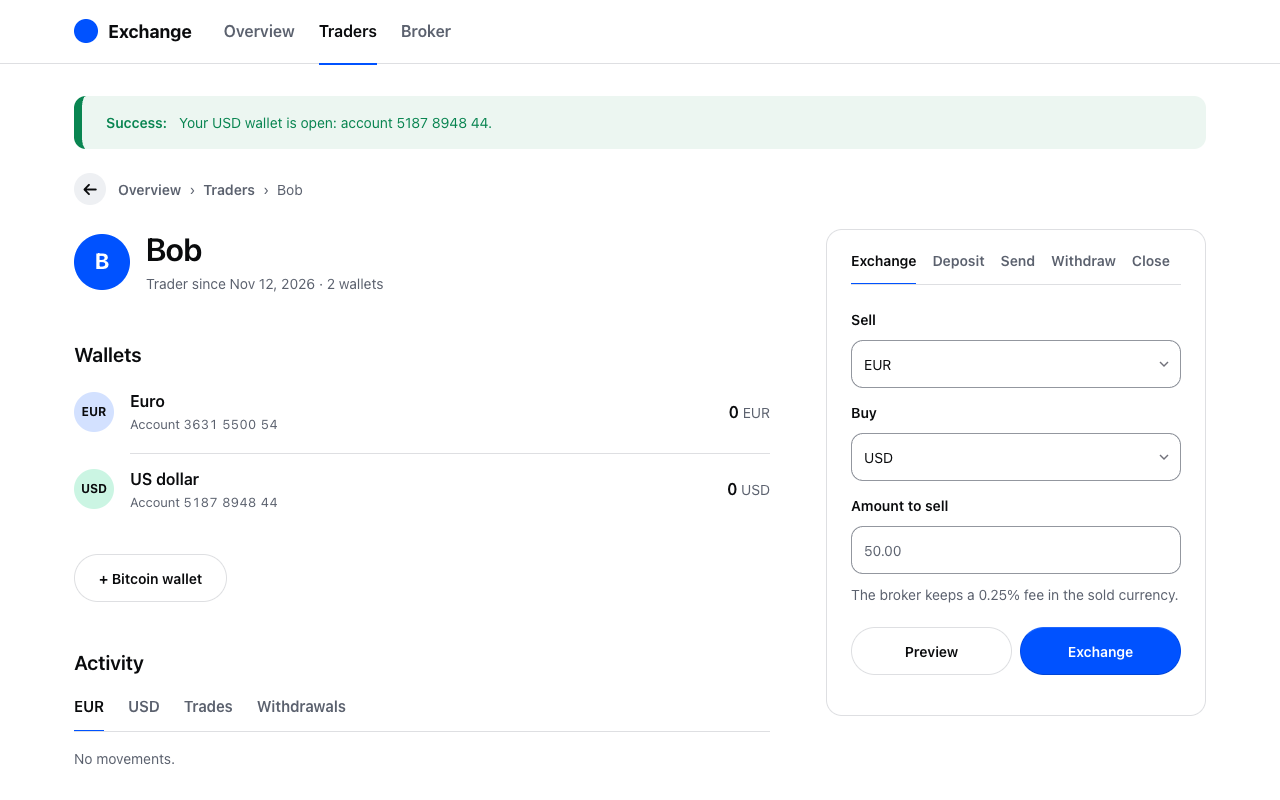
Alice types Bob’s EUR account number on the Send tab.
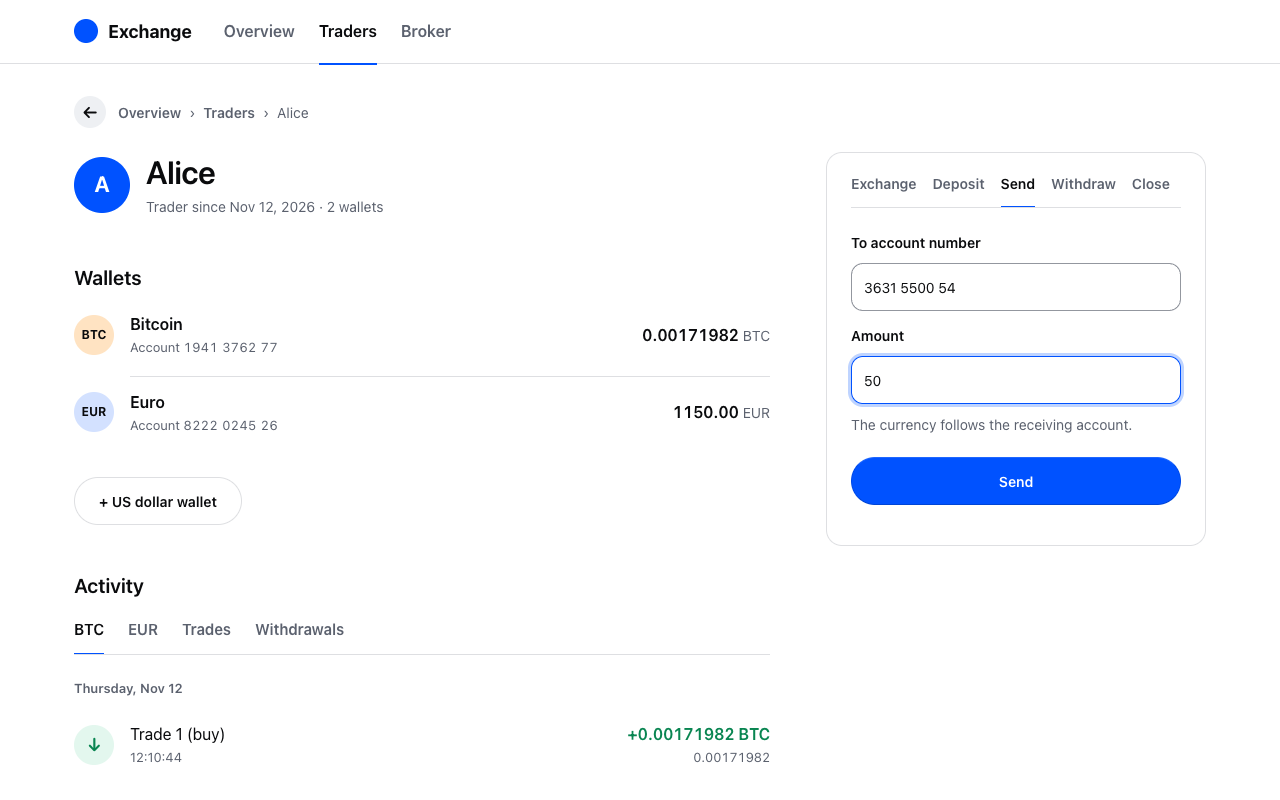
The number decides the currency. The Luhn check runs first, so a typo is reported as such, not as “no such account”:
def send(
    sender: Trader, to_account: str, amount: Decimal, *, transfer_id: TransferId | None = None
) -> Transfer:
    """Pay another trader. The recipient's account number fixes the currency."""
    recipients = Wallet.objects.select_related("trader", "account")
    try:
        recipient = recipients.get(number=parse_account_number(to_account))
    except Wallet.DoesNotExist:
        raise ValueError("no trader account with that number") from None
    # ...
    source = wallet(sender, recipient.currency).account
    metadata = {"kind": "payment", "from": sender.name, "to": recipient.trader.name}
    return source.transfer(recipient.account, amount, id=transfer_id, metadata=metadata)
In the ledger:
Alice EUR → Bob EUR 50.00 payment Alice → Bob
One transfer between two customers. The exchange’s accounts don’t move.
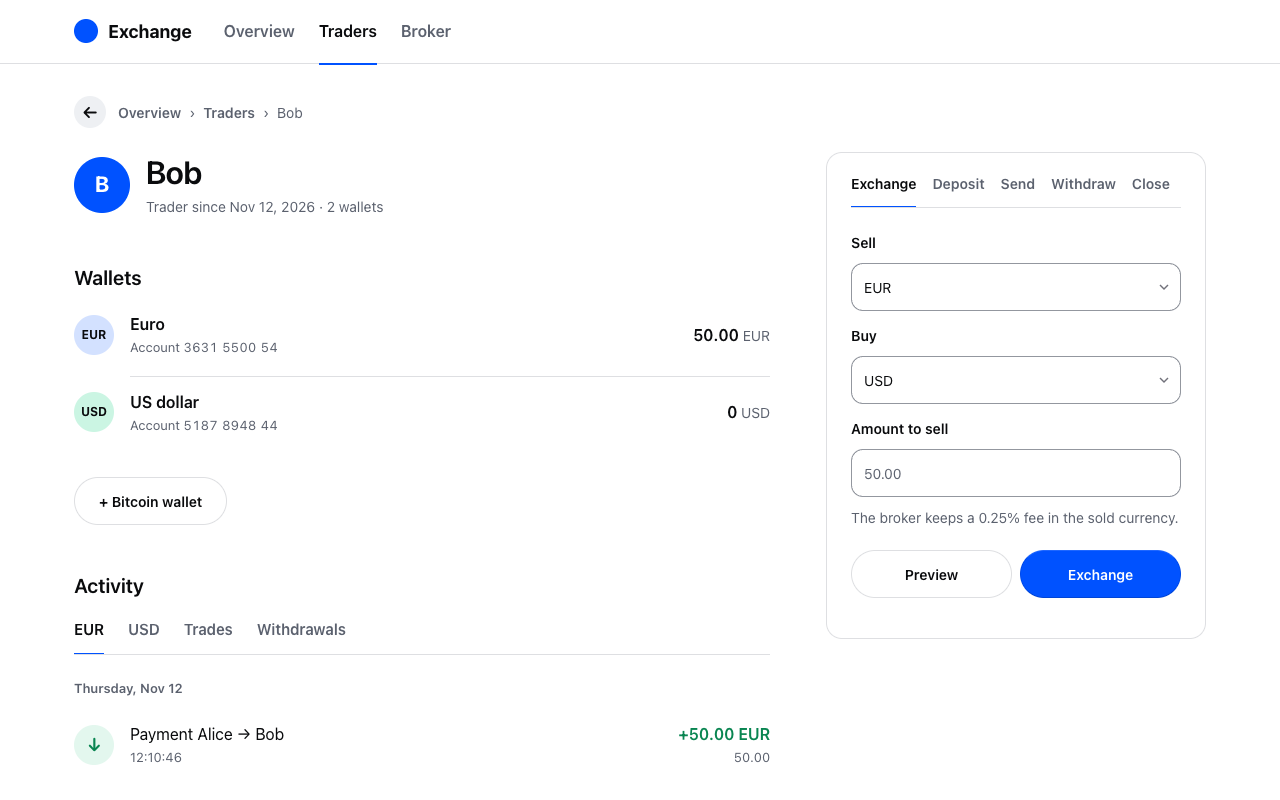
The statement comes from the ledger itself. Account.history() returns the account’s entries,
and each entry carries the balance right after it:
class WalletAccount(Account):
    class Meta:
        proxy = True

    def statement(self) -> list[StatementLine]:
        entries = self.history().select_related("transfer")
        return [
            StatementLine(
                at=entry.created_at,
                description=describe_transfer(entry.transfer),
                amount=entry.amount,
                balance=entry.account_current_balance,
                transfer_id=entry.transfer_id,
            )
            for entry in entries
        ]
7. Withdraw and close a wallet #
On the Withdraw tab, Alice takes 200 EUR out to her bank account.
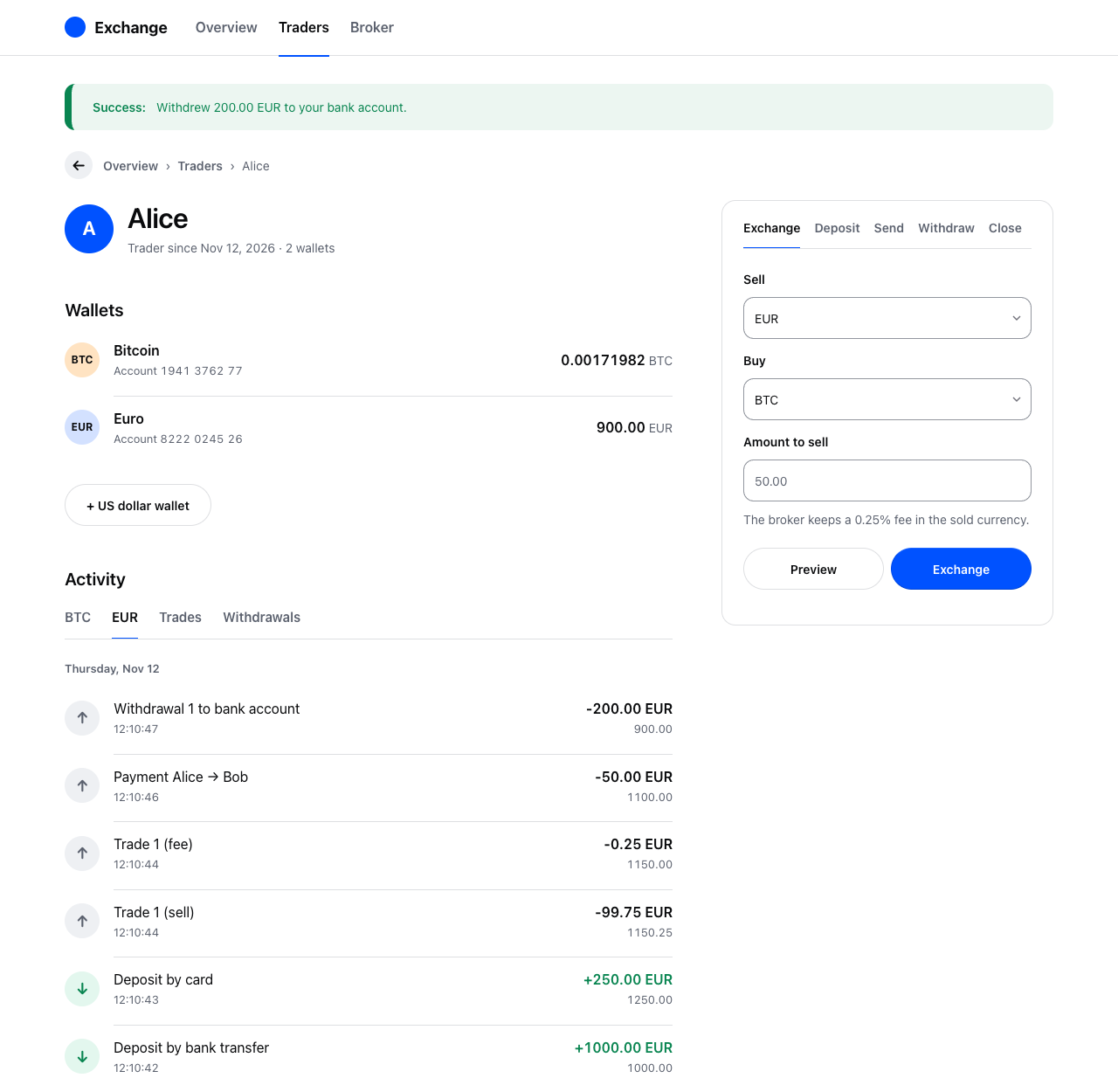
A withdrawal works like a trade: a Withdrawal row with a request_id and a stored
transfer_id, then one transfer out of the wallet:
def execute_withdrawal(withdrawal_id: int) -> tuple[Withdrawal, Transfer]:
    # ...
            account = wallet(withdrawal.trader_id, withdrawal.currency).account
            destination = payout_destination(withdrawal.currency, withdrawal.method)
            # ...
            try:
                transfer = account.transfer(
                    destination, withdrawal.amount, id=withdrawal.transfer_id, metadata=metadata
                )
            except (
                pledge.NegativeBalanceNotAllowed,
                pledge.PositiveBalanceNotAllowed,
                pledge.AccountClosed,
            ) as exc:
                withdrawal.status = Status.FAILED
                withdrawal.failure = failure_code(exc, {account.id})
In the ledger:
Alice EUR → bank EUR 200.00 withdrawal to bank account
The bank account goes back up by 200, toward zero: that money left the exchange.
PositiveBalanceNotAllowed is the bank’s own rule from step 2. A withdrawal that would push it
above zero is refused as insufficient_bank_balance.
Withdrawing to a card goes to the card account instead. The provider keeps its 1.5%, so Alice
receives less. That split is only noted in the transfer’s metadata; the ledger moves the full
amount.
Closing a wallet pays out what’s left, then closes the account, in one transaction. BTC can’t leave by bank or card, so Alice has to sell it first:
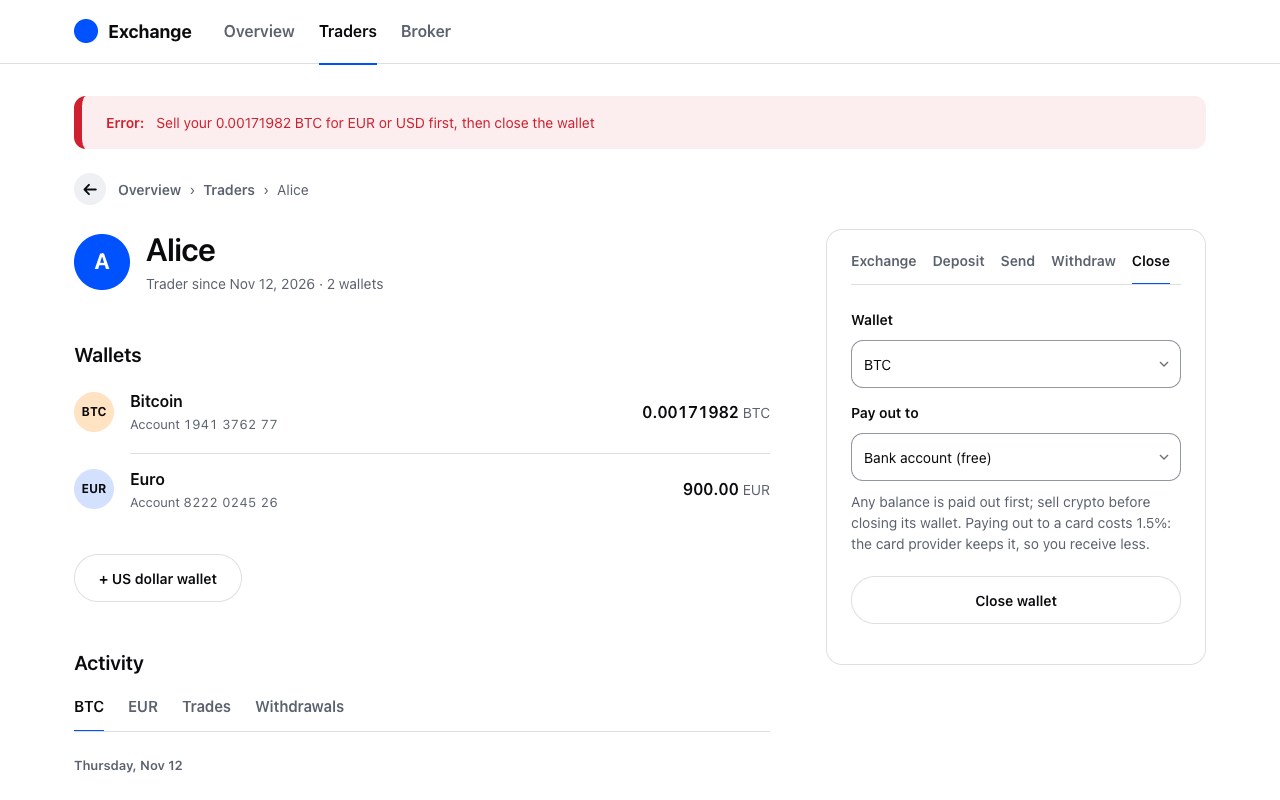
def close_wallet(trader: Trader | int, currency: str, method: str = "bank") -> Transfer | None:
    """Pay out any remaining balance and close the account, all or nothing."""
    # ...
    with transaction.atomic():
        account = wallet(trader, currency).account
        payout = None
        if account.balance > 0:
            if currency in settings.EXCHANGE_CRYPTO:
                others = " or ".join(fiat_currencies())
                raise ValueError(
                    f"sell your {format(account.balance, 'f')} {currency} for {others} first, "
                    "then close the wallet"
                )
            destination = payout_destination(currency, method)
            # ...
            payout = account.transfer(destination, account.balance, metadata=metadata)
        # close() checks the balance under its row lock: a late deposit raises AccountNotEmpty.
        account.close()
    return payout
A closed account stays in the ledger with its full history. pledge never deletes ledger rows.
8. The broker’s view #
The Overview page shows one row per currency: all traders together, each broker account, and the sum.
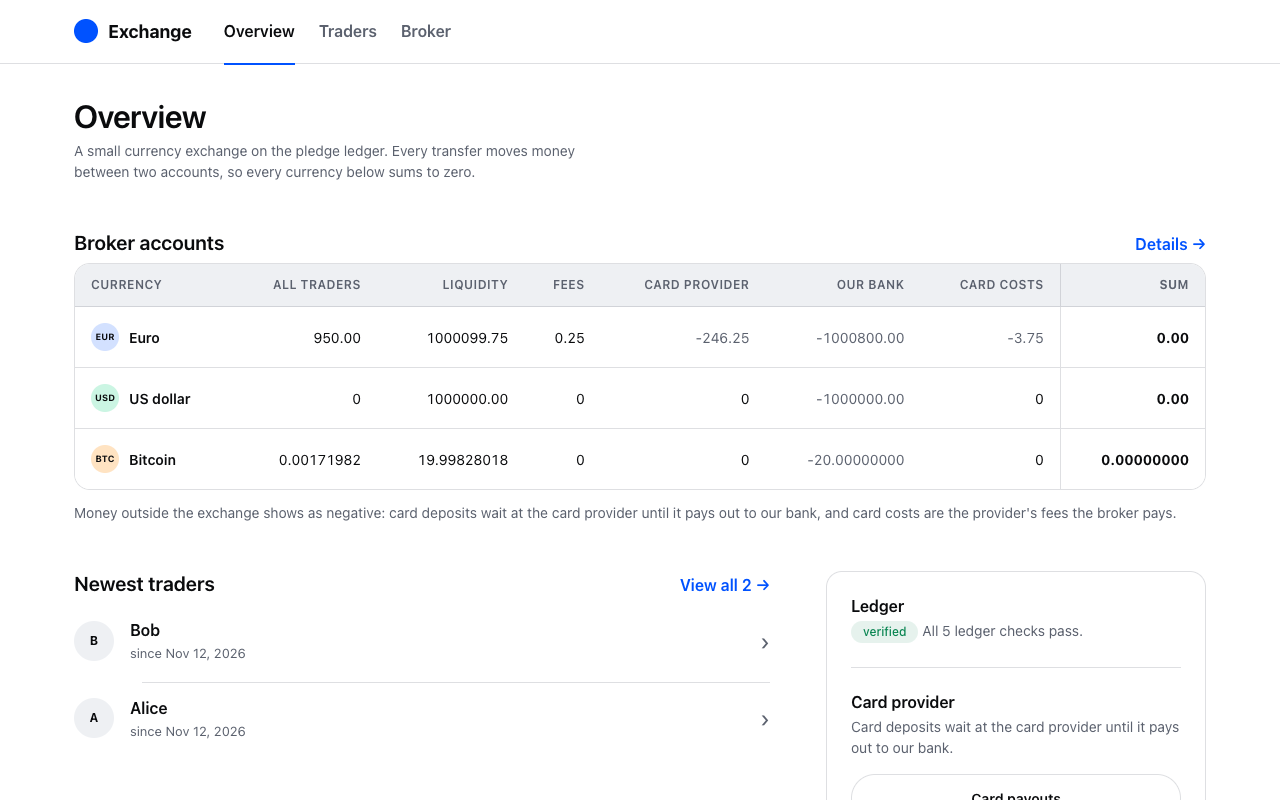
Check the EUR row: Alice’s 900 plus Bob’s 50 gives 950 for all traders. Add liquidity 1,000,099.75 and fees 0.25, and subtract what came from outside: bank 1,000,800, card 246.25 and card costs 3.75. The result is 0.00. It always is, because every transfer adds to one account exactly what it takes from another.
The table is three queries over the ledger:
def ledger_totals() -> dict[str, dict[str, Decimal]]:
    """Per currency: all customers together, each house account, and the ledger sum (always 0)."""
    # ...
    for row in HouseAccount.objects.values("currency", "kind", "account__balance"):
        totals[row["currency"]][row["kind"]] = row["account__balance"]
    customers = Wallet.objects.values("currency").annotate(total=Sum("account__balance"))
    for row in customers:
        totals[row["currency"]]["customers"] = row["total"]
    for row in Account.objects.values("currency").annotate(total=Sum("balance")):
        # ...
        totals[row["currency"]]["sum"] = row["total"]
    return totals
The Broker page lists the five accounts per currency, their recent movements, and what the card provider holds.
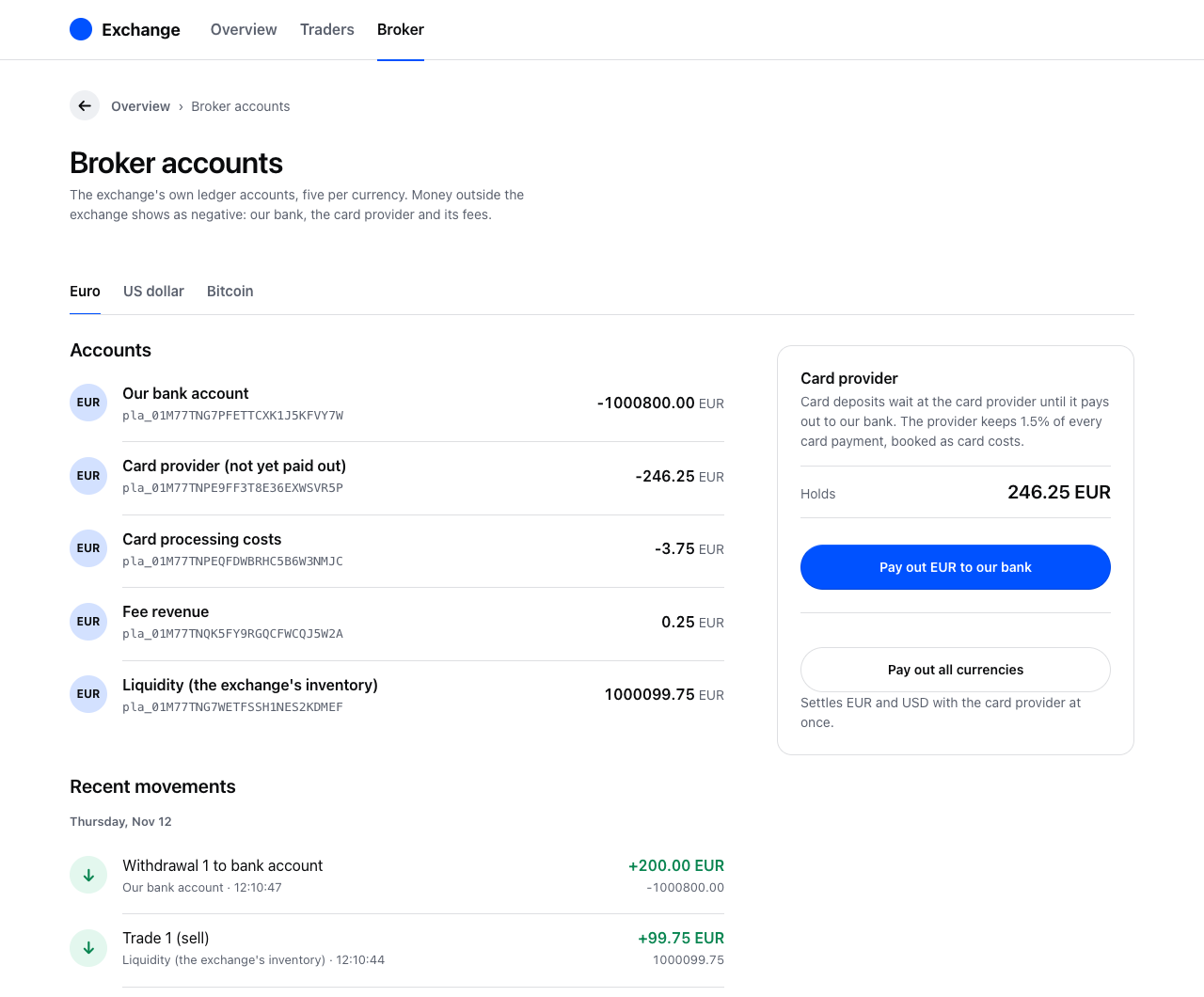
Pay out EUR to our bank settles with the card provider:
def payout(currency: str) -> Transfer | None:
    """Settle with the card provider: it pays out what it holds, or collects what we owe it."""
    # ...
    with transaction.atomic():
        # Concurrent payouts queue on this row, and each reads the balance only once it holds it.
        house = HouseAccount.objects.select_for_update().get(
            kind=HouseAccount.Kind.CARD, currency=currency
        )
        card = Account.objects.get(pk=house.account_id)
        if not card.balance:
            return None
        if card.balance < 0:
            return bank.transfer(card, -card.balance, metadata={"kind": "card_payout"})
        return card.transfer(bank, card.balance, metadata={"kind": "card_settlement"})
In the ledger:
bank EUR → card EUR 246.25 card provider payout
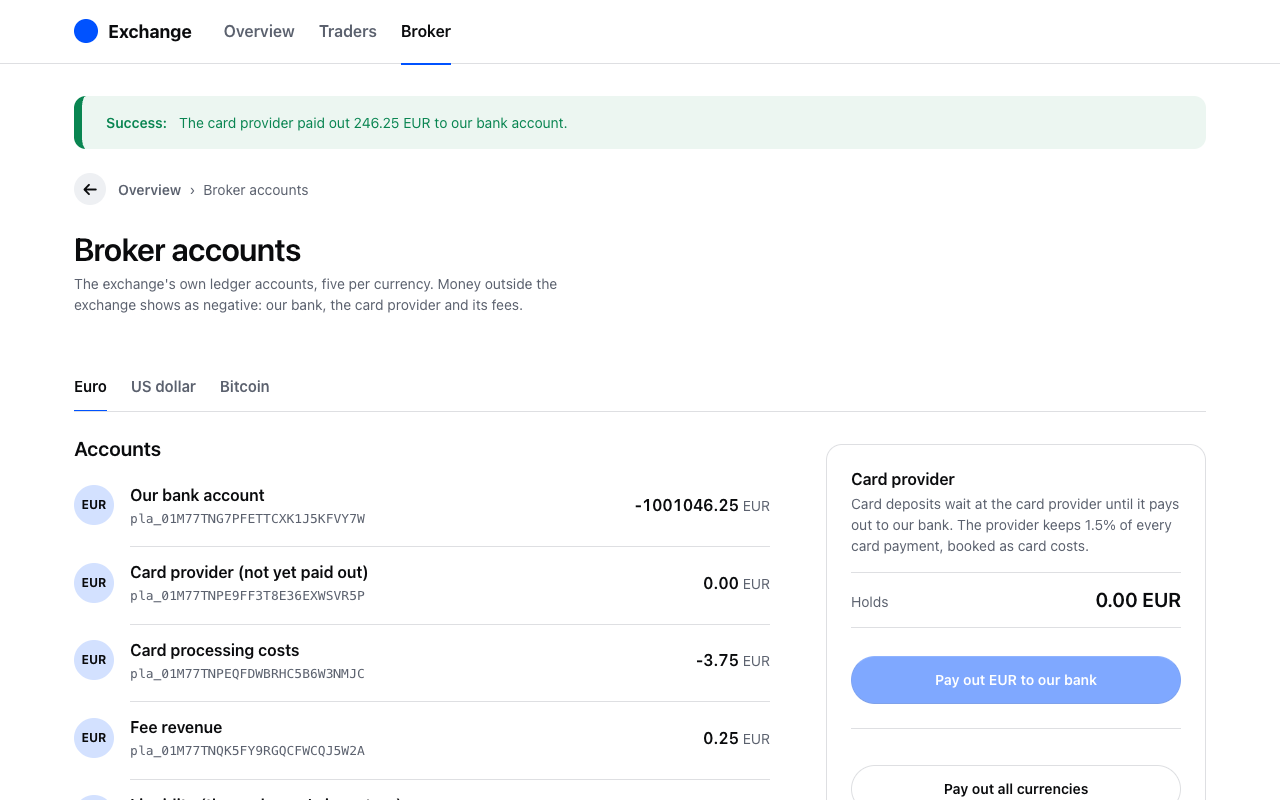
The card account is back at zero. The money now shows in bank, which only means it moved from
the provider to our real bank account. Nobody’s wallet changed.
9. Trust the books #
pledge can check its own books. pledge.verify() recomputes every balance from the entries and
checks every transfer. From Django:
from django_pledge.models import Account

Account.objects.verify()            # a list of checks, each with .ok
Account.objects.assert_verified()   # raises VerificationFailed if any check fails
The overview page runs verify() on every load and shows the verified badge. You’d run it
from a scheduled job in a real app.
The simulate command creates random traders and runs hundreds of deposits, trades, withdrawals,
retries and payouts against the running example. It then checks that every currency sums to zero
and calls assert_verified():
just example-simulate
# or: docker compose --profile example run --rm example python example/manage.py simulate
The test suite checks the ledger after every single test, with an autouse fixture:
@pytest.fixture(autouse=True)
def ledger_stays_consistent(house_liquidity):
    yield
    from django_pledge.models import Account

    Account.objects.assert_verified()
Add this fixture to your own project’s tests. Any bug that breaks the ledger then fails a test straight away.
Where next #
Transfers, batches, retries, history and errors in detail.
Link models to accounts, proxy models and the admin.
How pledge handles a transfer id it has seen before.
Every error code and what it means.